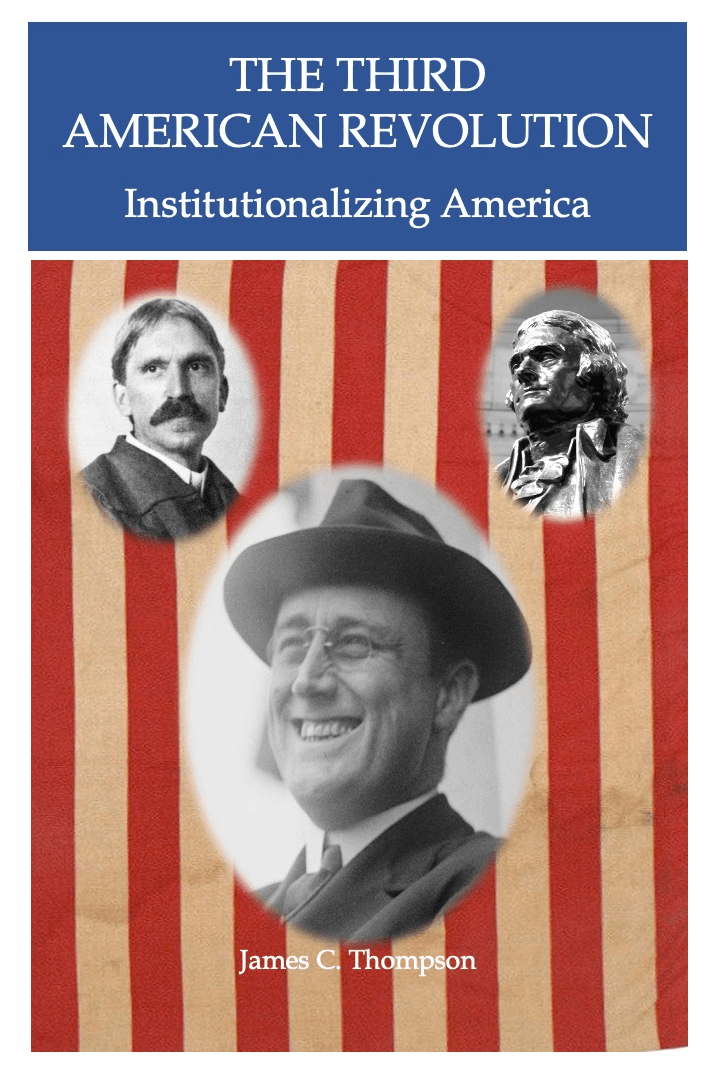
Book 4: The Third American Revolution – Institutionalizing America
NOW AVAILABLE ON AMAZON
The Third American Revolution is the final book in James Thompson’s four-book American Revolutions Series.
The author introduces it with a brief biography of John Dewey. Dewey became a social reformer whose untiring promotion of his programs paved the way for two great “reconstructions” of American society during the 20th century.
During the so-called “Roosevelt Revolution,” a network of New Deal bureaucrats transformed America’s “government by the people” into a benevolent government designed and administered by themselves.
Thompson stages the Roosevelt Revolution by remembering how WWI devastated the civilized world and how President Woodrow Wilson sought to create “peace without victory” and a “League of Nations” to end all future wars. Thompson folds into this part of his narrative Walter Lippmann, the Inquiry of Colonel Edward House, the House of Truth, and Felix Frankfurter.
A new generation of reformers came to power as Roosevelt’s New Dealers aged out. These were “civil humanists” who showed their humanism by supporting the civil rights movement and committing themselves to achieving social justice. Engaged intellectuals and cognoscenti were drawn into their network by the power it wielded. When media sorts joined later in the 1950s, an all-powerful hierarchy formed that involved itself in every aspect of American life.
Thompson adds details about the communities that formed this Imperial Hierarchy and the roles they played in fulfilling Tocqueville’s prophesy.
Divisions within it increased after the assassination of John F. Kennedy in November 1963. These divisions soon spread through the country. Thompson weaves the anti-war movement and other rebellions into his narrative.
For Thompson, the Woodstock Music Festival, which took place during the summer of 1969, was a culminating event. Out of the festival emerge Woodstock Nation. The third American Revolution ended, Thompson says, as Woodstockers matured in the 1980s. As national leaders, Woodstock Nation abandoned the social reform their mentors championed in favor of liberation. Instead of reforming American society, Woodstockers committed to dismantling it.
Thompson says liberation coalesced into a fourth American revolution, which he comments on. He focuses on the modernization of American education with its accompanying assault on western culture.